When you find out what the Long Tail means to you, personally, and to world-wide business, you will never be the same, and you will never view business again, in the same light.
I chose to review The Long Tail, by Chris Anderson, mostly because I have been hearing the phrase “the long tail” and I didn’t know what it meant. For those of you like me, the Long Tail refers to the tail-like appearance, on a graph, looking from left to right. The reference to the Long Tail refers to the very long, very narrow tail at the rightmost end of the curve. Something that is very long and very narrow at the right of the graph indicates a potentially very large, but very dispersed group of something. In this case, the “group of something” is people’s taste in a very wide variety of things they want to buy: music, books, clothes, antique tile, exotic pets, hiring a dominatrix.
The book gets four stars on Amazon but I found the reviews less than helpful. This was unusual for me. I usually find Amazon reviews enormously helpful. In this case, that wasn’t true because I wasn’t trying to decide whether to buy the book or not. When I’ve heard a term like “the Long Tail” for several years now and I still don’t know what it means AND it’s a potential read for a class, the reviews don’t matter; I’m going to buy the book. After having bought the book and then reading the reviews, they remained equally unhelpful; I had read the book, have my own opinion and don’t much care what others have to say.
As far as engaging my potential readers, I’m not yet familiar enough with things like SEO, RSS and “engaging hyperlinks” to be able to assess how well I might be attracting potential readers. I tried to lead this review with an engaging sentence. Other than that, I am still a bit baffled, despite our weekly reading, how to actually capture an audience within a blog. I think, as we read in the article about monetizing your blog, it’s not easy.
My personal opinion of the book is that it’s an extremely dense read. I’m a tax attorney by training, and you can only imagine how dense a text must be in order for me to consider it dense. Not Internal Revenue Code dense, not legal contract dense. But dense, nonetheless. It’s replete with statistics, equations, and numerical comparisons that made my head swim. If you can wade through this immensely dense presentation of facts, what you come away with is that there is now available, due to the economies of scale made available primarily through the internet, a nearly unlimited niche market for anything. You name it. Custom-made clothes, books that haven’t been in print for 50 years, music, beer, whatever. Even the pornography industry has a long tail. Name your (er, your good, but weird friend’s) kinky interest and, I guarantee (though not through person research) that there’s a website that’s just for you.
When Dawn mentioned blogging for a living and a blog about remarkable women, I was reading The Long Tail at the time and my response to Dawn’s question about what we thought about monetizing such a blog was that it was not only possible but probable. Easy. In my comment to her post I even suggested that a blog about remarkable, left-handed brunettes would be viable. That’s what the long tail means; there are now so many niches, with people in them who are ready to pay money based on their niche interest, that there isn’t anything anyone can imagine that can’t be monetized, if marketed in the right way.
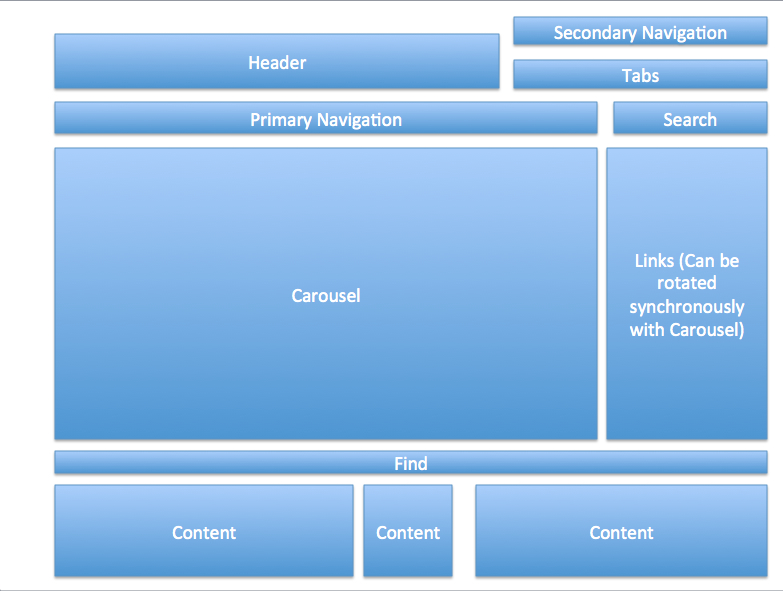 This is a wireframe of Chatham.edu. I built it in reverse, just as an exercise in wireframing.
 scottmacleodsblog